For executives working across China and the United States

The instincts that made you successful at home are the ones that stall you abroad.

Every year, capable Chinese founders walk into American boardrooms and capable American executives fly into Shanghai, and both sides watch good deals die for reasons no one can name. This book names them, then shows you what the leaders who succeed do differently.

Available now in hardcover, paperback, and Kindle.

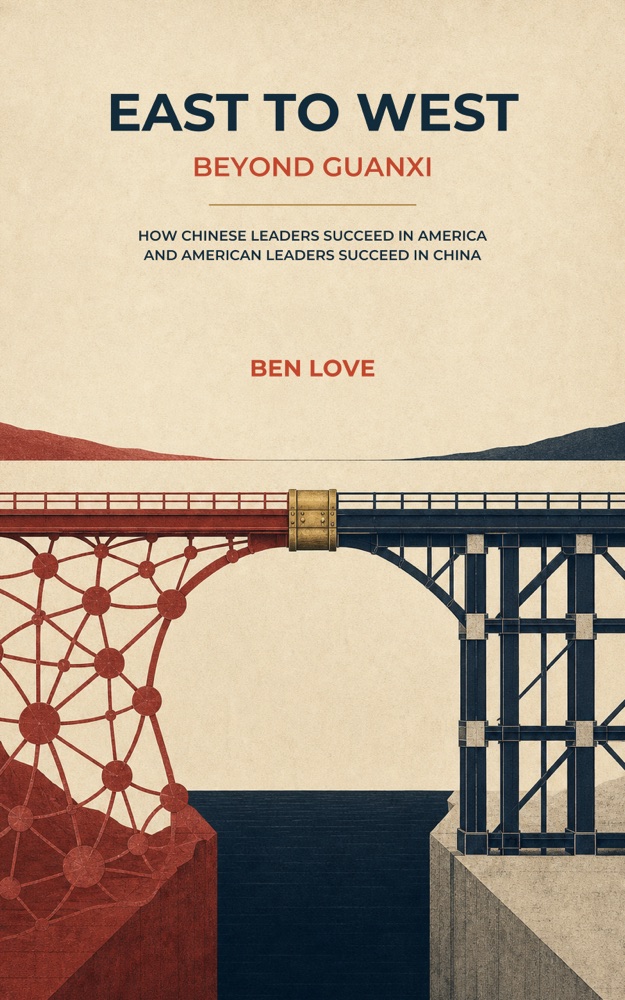
East to West: Beyond Guanxi book cover. A bridge built from a red relationship network on one side and a navy structural grid on the other, joined by a brass connector.
5
Structural frameworks
11
Chapters, one per fault line
11
Original field diagrams
2
Directions, one bridge

The problem

The same mistake, made in both directions

The book calls it the Home-Market Fallacy: world-class companies fail abroad not because they abandon their disciplines, but because they apply them faithfully. The rules that made them great at home are precisely the rules that break them abroad.

East to West

The founder on Sand Hill Road

You spent a decade building relationships that vouch for you completely. Eleven minutes into your pitch, a partner interrupts: "Why should we care?" The patience and indirectness that signal seriousness in Shenzhen read as evasion in Menlo Park. The meeting is over before you understand what happened.

West to East

The executive who asked for Friday

You sent the deck, ran the meeting, and asked for a decision by end of week. Three weeks of silence later, you learn the real meeting happened after your meeting, and you were not in the room. The directness that signals competence in Chicago closed doors in Chengdu, quietly and permanently.

These are not etiquette failures. They are collisions between two rational systems that carry trust, authority, speed, and risk through different structures. Etiquette tips will not save you. Understanding the structures will.

The five-part framework

A working model of both systems, not a list of customs

Guanxi gets you in the room. What happens next depends on whether you can read the machinery on the other side. The book maps that machinery in five parts.

01

The Trust Architecture

Why trust builds slowly in one system and quickly in the other, why each is rational, and how to be credible in both at once. Includes the communication bridge and the velocity balance.

Chapters 1 to 3
02

The Autonomy Gradient

Who decides what, how much authority a team expects, and how to set delegation that holds under pressure instead of collapsing into either micromanagement or drift.

Chapters 4 to 5
03

The Capital Horizon

What investors on each side actually reward: the conviction premium in one market, the scorecard in the other, and how to present the same company credibly to both.

Chapters 6 to 7
04

The Market Bridge

Translating product, experience, and attention for buyers who read entirely different signals, without flattening what made the offer win in the first place.

Chapters 8 to 9
05

The Operational Firewall

Compliance, governance, and crisis response that survive scrutiny in two jurisdictions at once, built before the storm rather than during it.

Chapters 10 to 11

Inside the book

Eleven chapters. Eleven fault lines. Both directions, every time.

Every chapter ends with concrete guidance in both directions: what the Chinese executive entering America should do, and what the American executive working with China should do.

Part One: The Trust Architecture

01The Trust Asymmetry
02The Communication Bridge
03The Velocity Balance

Part Two: The Autonomy Gradient

04Setting the Gradient
05From Harmony to Empowerment

Part Three: The Capital Horizon

06The Conviction Premium
07The American Scorecard

Part Four: The Market Bridge

08The Experience Translation
09The Attention Translation

Part Five: The Operational Firewall

10Building the Firewall
11The Glass House

Built for practitioners

No dragons. No eagles. No handshake photos.

Just the machinery. Each chapter carries an original diagram that turns the pattern into something you can put on a whiteboard, plus masterclass cases drawn from the documented record: Lenovo, Smithfield, Alibaba, Haier, Fuyao, and leaders who crossed in both directions.

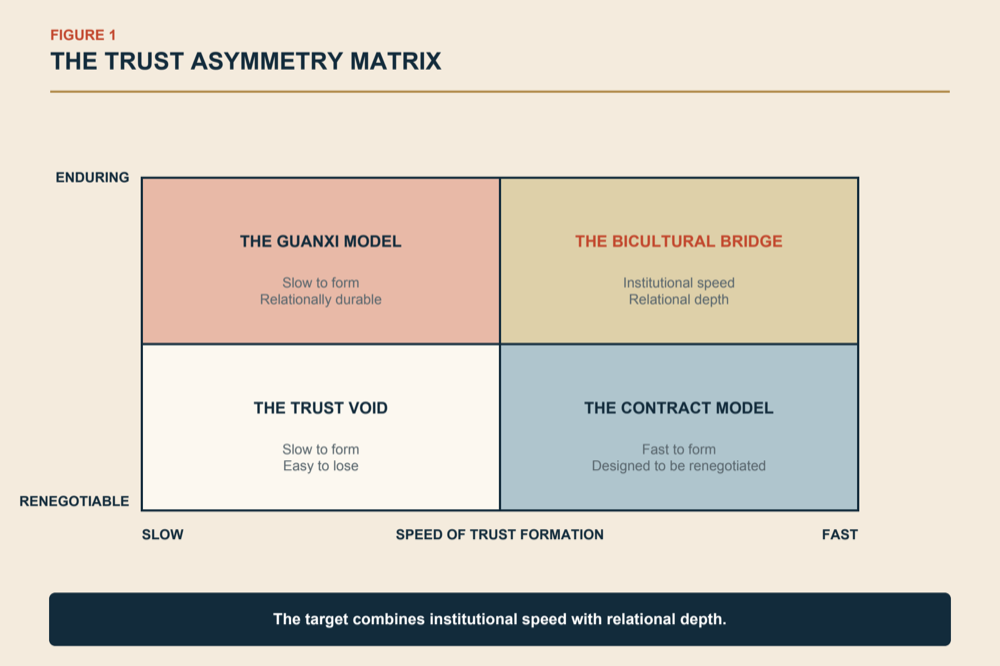
Diagram: the Trust Asymmetry Matrix, comparing relationship-carried and institution-carried trust systems.
Ch. 1 · Trust Asymmetry Matrix
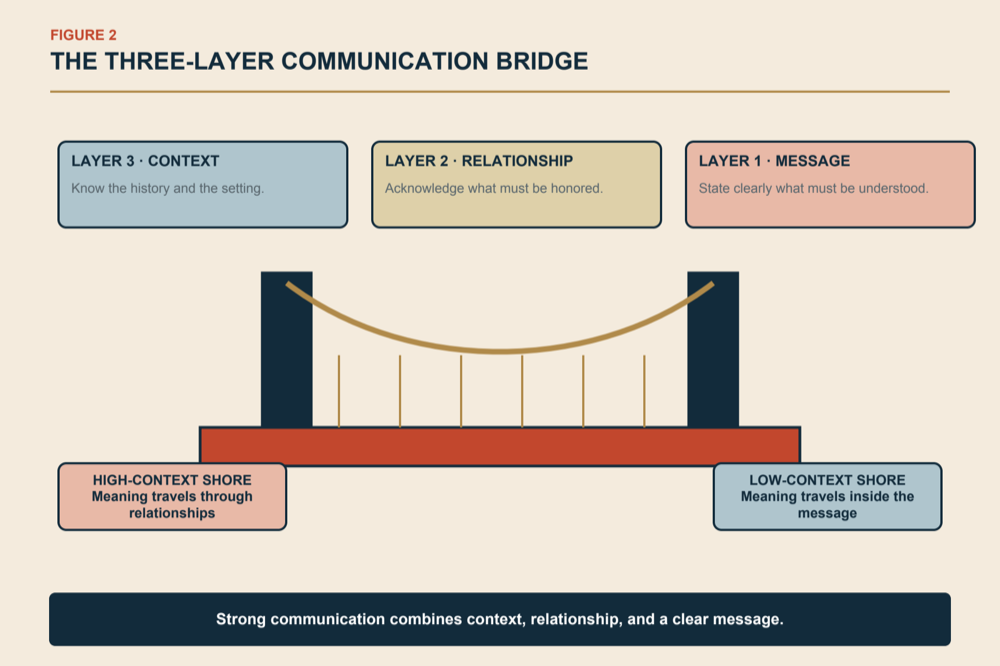
Diagram: the Three-Layer Communication Bridge between high-context and low-context styles.
Ch. 2 · Communication Bridge
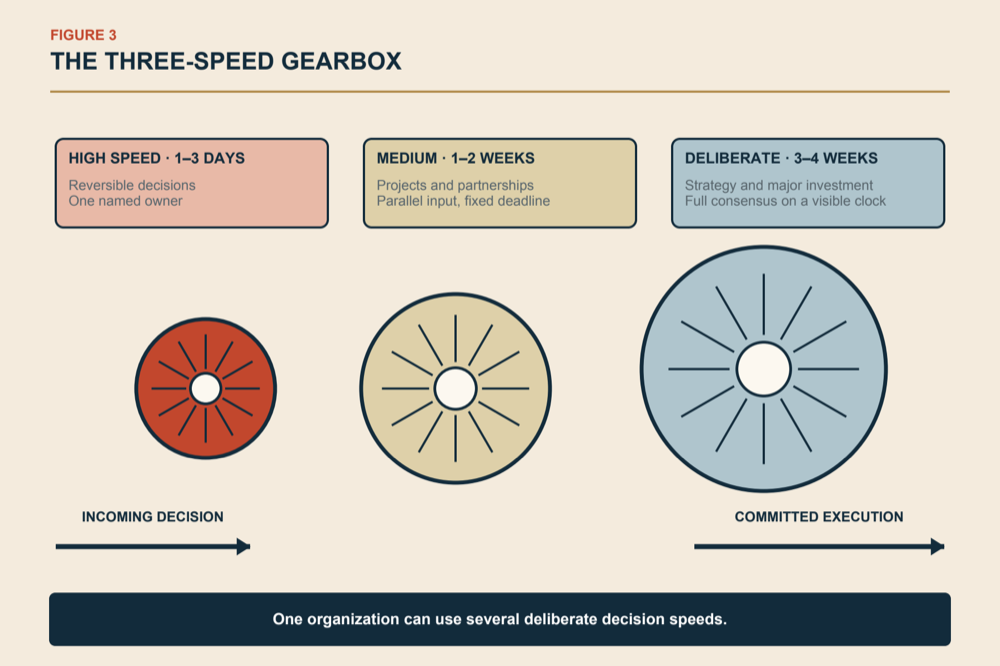
Diagram: the Three-Speed Gearbox for matching decision speed to decision type.
Ch. 3 · Three-Speed Gearbox

You will learn how to:

  • Build trust across relationship-first and institution-first systems
  • Translate presentations, decisions, metrics, products, and channels
  • Create authority and governance that stay credible under pressure
  • Recognize when a cultural problem is actually structural

Available now

Start crossing the bridge today.

Hardcover, paperback, and Kindle. Ships from Amazon US.

The author

Ben Love, author of East to West: Beyond Guanxi

Ben Love

Ben Love writes about how Chinese and American companies actually work together, beyond the airport-bookstore clichés. East to West: Beyond Guanxi was built from published research, public records, practitioner observation, and clearly labeled composite cases from both sides of the Pacific.

He wrote it for the leaders responsible for making China-US business work in practice: founders raising abroad, executives managing across the ocean, and the boards and investors who back them.